

A Piecemeal Descent of the Deschutes
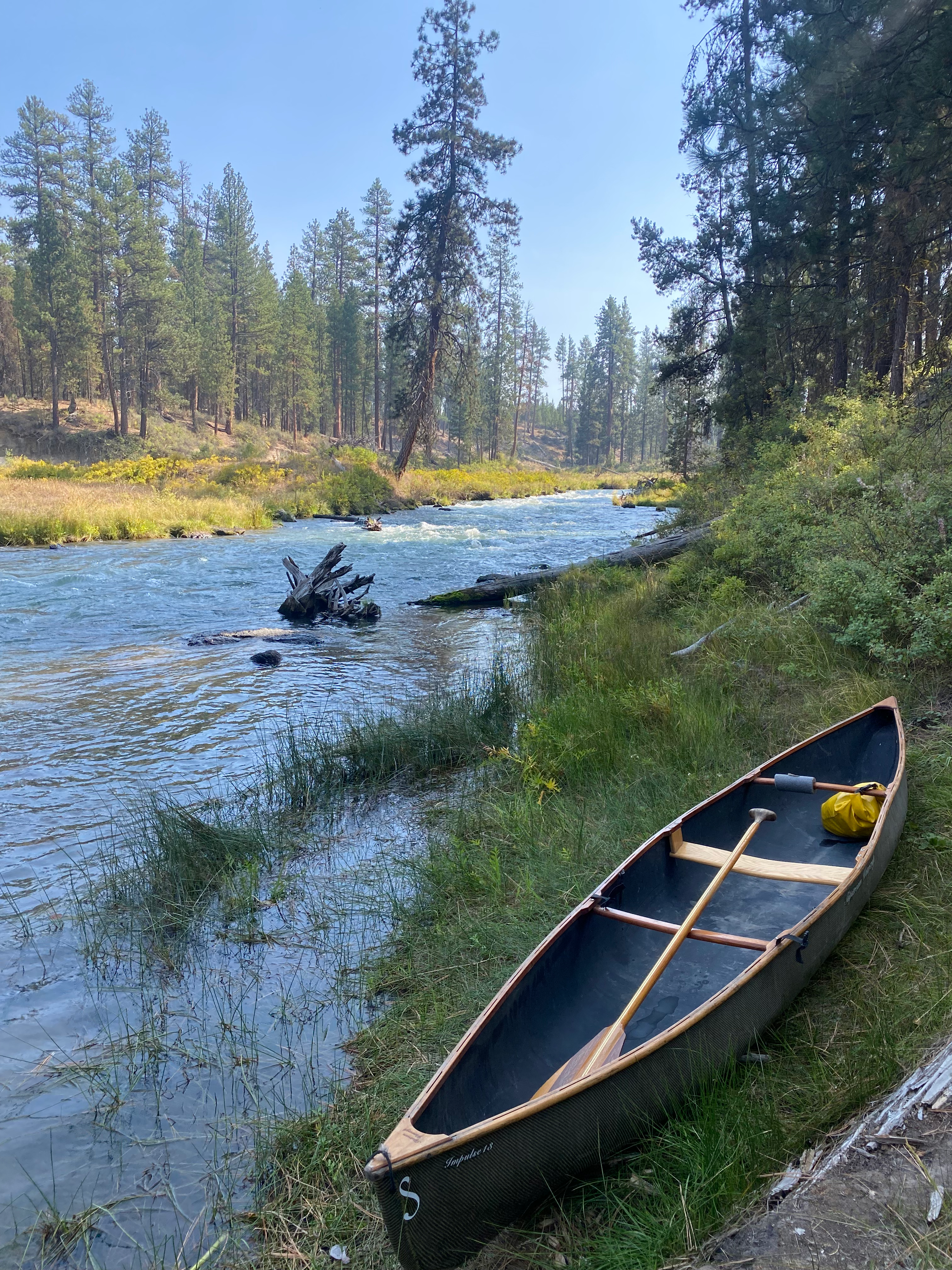
Tim Case's Impulse 13 Story

The Deschutes River bisects much of the state of Oregon from its headwaters high in the Cascade mountain range north to its confluence with the Columbia River. While the Deschutes has long been a favorite of all types of paddlers, most concentrate on just a
few miles near Sunriver and Bend and the downstream sections near Madras, Oregon.
I paddled my first section of the Deschutes three years ago from LaPine State Park to the resort town of Sunriver, Oregon. It is beautiful! Many sections flow through public lands with no development. The flow in this particular section is absolutely flat and steady. You can complete this section in a couple of hours by doing little more than staying in the current. By the time I reached the takeout, my mind was already made to paddle the river end-to-end.
I learned that the Deschutes runs over 250 miles, and includes many calm sections as well as some serious whitewater, a few generally un-runnable drops, an urban section
through downtown Bend, three significant reservoirs, and a very remote and long Wild and Scenic section.

While I had hoped to paddle the entire river in my Slipstream Impulse 13, it quickly became clear that, while this was the perfect boat for much of the river, several sections were either too shallow, too wild, or too obstructed for my ultralight canoe. I’ve paddled the Impulse 13 on well over 100 miles of the river so far, but I’ve had to compromise by portaging the big rapids, hiking a section where shallow rapids emptied directly into a long, deep canyon, making the water inaccessible. I have run a couple rocky fast sections in an inflatable kayak or a stand-up paddle board, and used a 15-foot raft with center-mounted oars for the class 3-4 rapids along the final 100 miles.
From the Cascade Lakes region, the Deschutes runs crystal clear and cold from springs beneath Little Lava Lake. It makes its serpentine way through ponderosa pine forests, blasts through narrow lava canyons, then runs smooth and strong across the high desert plains of the Warm Spring Indian Reservation before making its contribution to the mighty Columbia River near The Dalles, which carries its water on to the Pacific Ocean.
Because of changing water levels, permit availability for the W&S section, and other travel commitments, running the Deschutes top to bottom has not been possible, so I’ve just done different sections as factors allowed, and consequently, after two summers, have one top section and one lower-middle section to complete the river.
Strangely, the lower wild and scenic section with its remote, roadless
setting, strong current, and frequent rapids did not prove the most difficult section. The first six miles at the other end look to be the most challenging and, oddly, the riskiest. Exiting Little Lava Lake, the stream bed is only a couple of feet deep and is rarely more than 50 feet wide. This narrowness makes almost every fallen tree a bank-to-bank obstruction. Spring snowpack runoff has carried most of the branches away, minimizing strainer risk, but many trunks lie just at water level, with most of the current flowing under. This creates a subtle but significant risk of pinning a broached boat, and maybe its paddler.

This fall, after a 500-yard paddle across Little Lave Lake, I entered the headwaters of the river and immediately had a frustrating first mile of mostly wading and lifting my Impulse over the first fifty logs. I was appreciating having an ultralight boat while simultaneously wishing I had no boat at all!
I plan on returning next summer with a wetsuit, helmet, life jacket, and a bogie board for what will be essentially a 5-mile wade/swim to the point where the river opens up enough to allow paddling.
That top six miles, a crossing of the Billy Chinnock Reservoir including a portage over the dam at the bottom, and a section down to the town of Warm Springs will complete my journey on this wonderful western river. More to come!
Have you paddled out west?
Yes, but not ultra-light
Yes, I have!
I'm from the west!
No, sadly. . .
Comments